


Born and raised in the Upper East Side of Manhattan, artist Helen Frankenthaler was exposed to the rapidly changing New York City art scene from a young age. During her studies with abstract artists Rufino Tamaya, Wallace Harrison, Hans Hofmann and Paul Feely, Frankenthaler was encouraged to emulate the cubist work of Picasso.
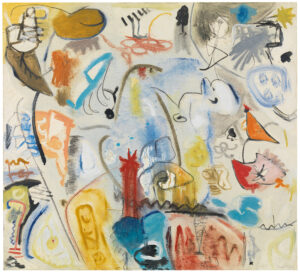
In her 1951 piece, Circus Landscape, Frankenthaler utilized geometric forms and dark linework reminiscent of the cubist work emerging around her. In this work, you can see Frankenthaler begin to explore her own style, incorporating more organic shapes and washes of color that are not clearly defined. That same year, Frankenthaler visited the studio of Jackson Pollock and was inspired by how he dripped his paints onto a canvas on the studio floor.
Newly motivated to expand her horizons and explore new techniques, Frankenthaler created her revolutionary soak-stain technique in which she thinned paints to pour over the canvas. “My medium is a combination of turpentine, tube paint, and enamel,” explained Frankenthaler.
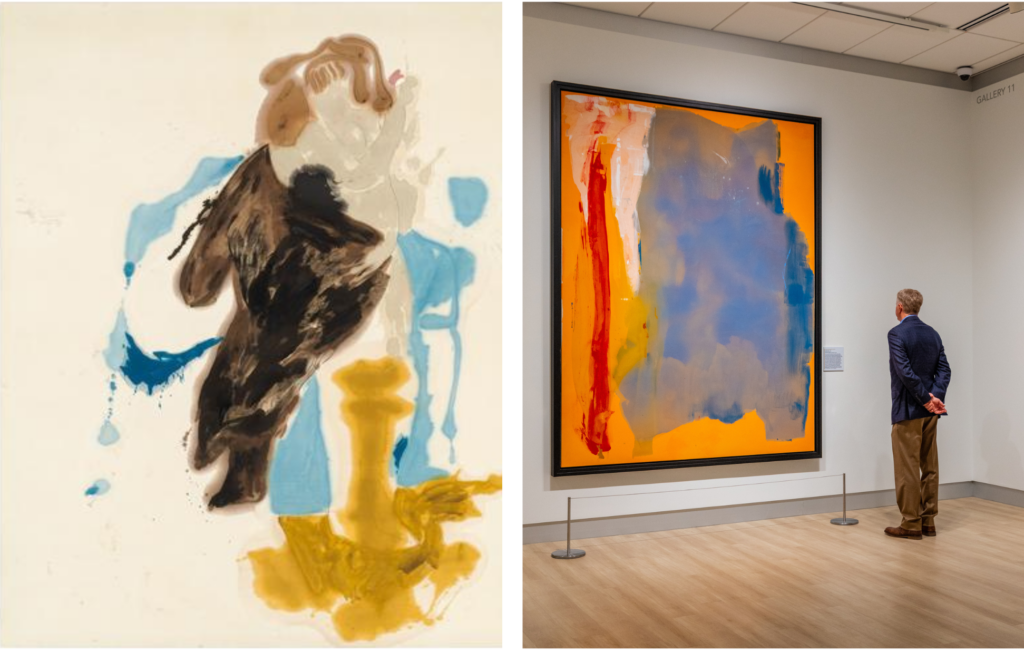
To plan out the composition of her works, Frankenthaler sketched faint outlines in charcoal. In her 1961 piece, After Rubens, Frankenthaler used oil paints to execute her soak-stain method. When mixed with turpentine then dried, oil paints cast a gauzy halo around the initial pour sites, as is seen in this piece. Unsatisfied with the inability to control the spread of these oil halos, Frankenthaler began to use acrylic paint for the soak-stain method instead.
Her transition to acrylic can be seen in Bending Blue (1977). In her later works, Frankenthaler abandoned planning her pieces in charcoal, focusing instead on creating large fields of color heavily inspired by nature.
Visit “Abstract Expressionists: The Women” to see examples of Helen Frankenthaler’s work and more! This exhibition is on view now through April 26th, 2026. Tickets to the exhibition are available now at muscarelle.wm.edu or upon entry. Admission is $12.
“Abstract Expressionists: The Women” is organized by the American Federation of Arts from the Christian Levett Collection and FAMM (Female Artists of the Mougins Museum), France. The exhibition is curated by Dr. Ellen G. Landau. It is generously supported by Berry Campbell Gallery, Betsy Shack Barbanell, Monique Schoen Warshaw, Christian Levett, and Clare McKeon and the Clare McKeon Charitable Trust. Additional support has been provided by the Pollock-Krasner Foundation and the Every Page Foundation.
■ Holly Gardner, Events & Education Coordinator