

In First Looks & Favorites from the Permanent Collection, long-standing works in the Muscarelle collection are presented alongside recent acquisitions, creating new contexts for familiar pieces. These established works—many of which have helped define the collection over time—take on renewed significance when viewed in dialogue with newer additions.
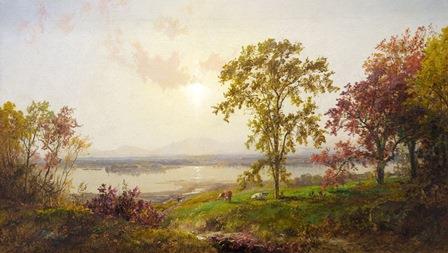
Jasper Francis Cropsey’s Autumn Landscape (1875) reflects the museum’s holdings in 19th-century American painting and the traditions of the Hudson River School. Trained initially as an architect, Cropsey brought a strong sense of structure to his landscapes, which often emphasized clarity, balance, and detail. His depictions of the American Northeast, particularly autumn scenes, were widely recognized for their vivid color and technical precision, Within the exhibition, Autumn Landscape anchors a broader consideration of how artists have interpreted the natural world.
JASPER FRANCIS CROPSEY | American, 1823-1900 | Autumn Landscape, 1875 | Oil on canvas | Purchase, Endowment Acquisition Fund, Museum Acquisition Fund and Joseph and Margaret Muscarelle Art Endowment Fund | 1994.090
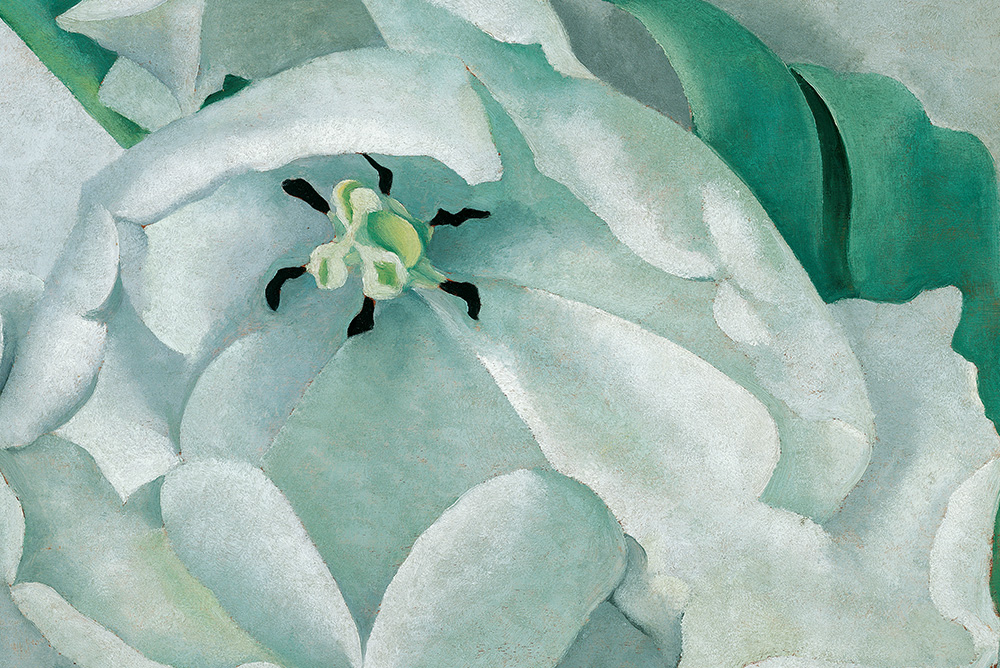
Georgia O’Keeffe’s White Flower (1932) holds a particularly significant place within the Muscarelle’s collection. Gifted to William & Mary in 1934 by Abby Aldrich Rockefeller, the painting represents an important acquisition for the University’s art collection that later led to the opening of the Muscarelle Museum of Art. O’Keeffe’s large scale depictions of natural forms, especially flowers, challenged the conventional expectations of subject and scale. In White Flower, the magnified bloom fills the composition, emphasizing form and abstraction. Its continued prominence within the collection reflects both its historical importance and its lasting visual impact.
GEORGIA O’KEEFFE | American, 1887-1986 | White Flower, 1932 | Oil on panel | © Georgia O’Keeffe Museum, ARS | Gift of Mrs. John D. Rockefeller, Jr. | 1934.007
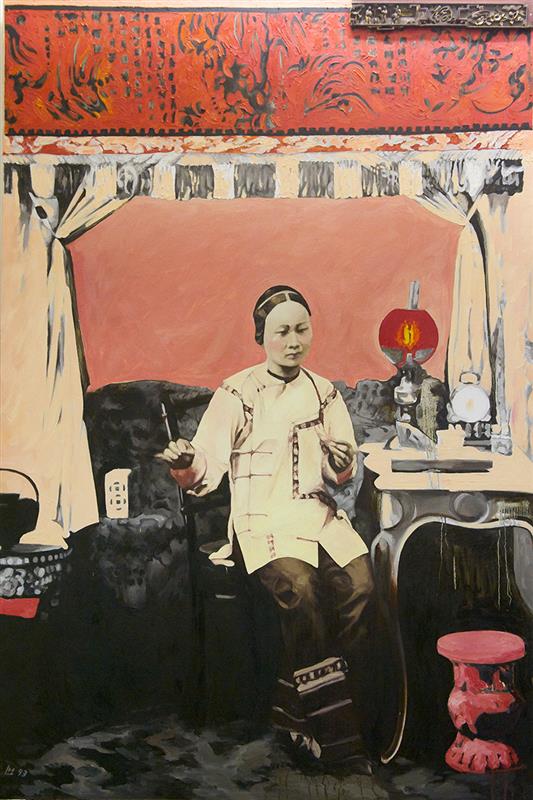
A more contemporary perspective is found in Hung Liu’s Raising the Red Lantern (1992-1992), a work that engages directly with history and memory. Drawing from archival photographs, Liu reinterprets images of women in pre-revolutionary China through layers of paint and the incorporation of mixed media elements. Her practice reflects an ongoing interest in the relationship between documentation and interpretation, as well as the ways in which histories are constructed and preserved. In the context of the exhibition, the work’s material complexity and layered imagery resonate with newer works that similarly explore identity and narrative.
HUNG LIU | Chinese-American, 1948-2021 | Raising the Red Lantern, 1992-1993 | Oil on canvas and wood architectural fragment | © Hung Liu | Purchase, Gene A. (W&M 1952) and Mary A. Burns Acquisitions Fund | 1996.085
These works are on view alongside many others in First Looks & Favorites from the Permanent Collection. Visit the Muscarelle Museum of Art to see them on view through June 7, 2026.
■ Emma Anderson ’26, Marketing & Events Intern